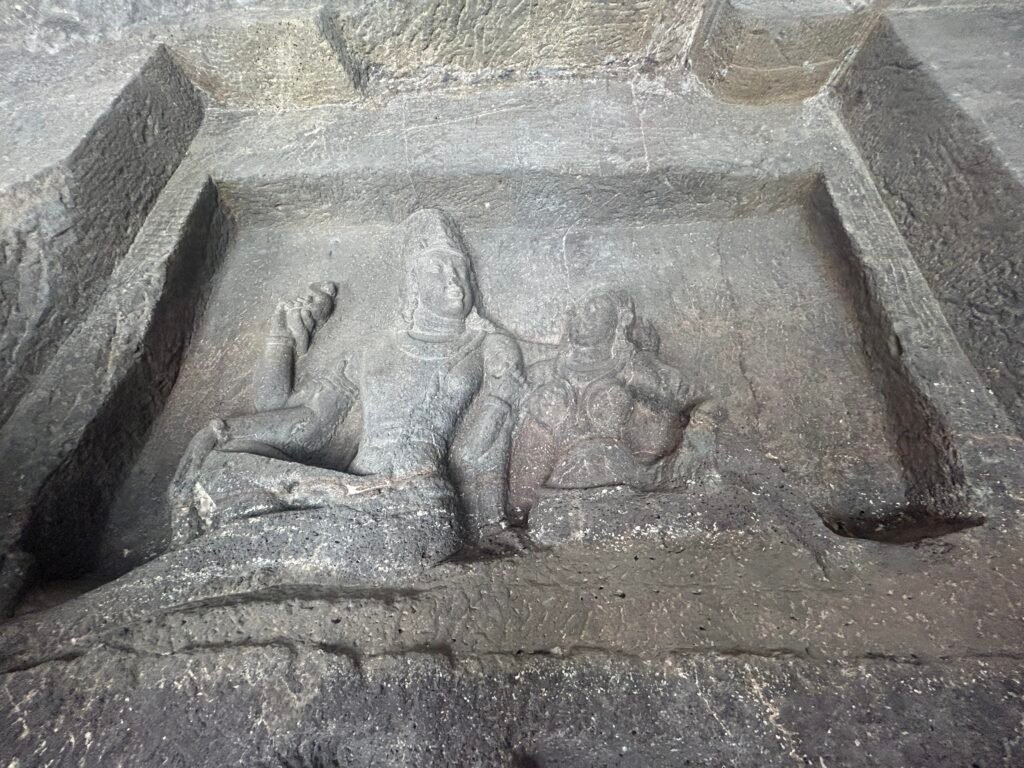
The first instinct inside the Kailasa Temple is to look up — and then to stop. Scale interrupts intention. The body hesitates, unsure where attention should settle, because nothing here offers a single centre. Stone rises, recedes, opens, encloses. What you are inside does not behave like a structure meant to be grasped all at once.
Understanding feels misplaced almost immediately.
The temple does not explain itself, and trying to make it do so feels intrusive. Carvings multiply across surfaces without hierarchy. Courtyards open where walls might be expected. Movement happens vertically and laterally, pulling the body into constant adjustment. Standing still does not help. Neither does walking with purpose. The space resists efficiency.
Inside Kailasa, orientation replaces interpretation.
You move because the space asks you to. You pause because your body needs to recalibrate. Distance becomes something you feel rather than measure. There is no correct vantage point, no moment of completion. The temple does not resolve into a single idea or image; it remains deliberately unfinished in the mind, even though it is meticulously complete in form.
What becomes clear is how much effort goes into trying to understand monumental places — and how unnecessary that effort can be. Here, meaning does not arrive through explanation. It arrives through endurance. Through time spent circling, stepping back, leaning inward, craning the neck, and eventually letting go of the need to categorise what is being seen.
The stone carries labour visibly. Not as spectacle, but as density. The knowledge that this space was not assembled but removed — released from rock through patience and repetition — changes how the body stands inside it. You are not witnessing construction; you are inhabiting absence shaped with intention. What remains is volume, shadow, and restraint.
Standing there longer than expected, the mind begins to quiet. Questions thin out. The urge to photograph recedes. Attention shifts from detail to sensation — cool stone, shifting light, the sound of footsteps echoing briefly and then dissolving. The temple becomes less an object of awe and more a condition you are temporarily subject to.
Leaving Kailasa, there is no sense of having understood it better. Only the awareness that understanding was never the point. Some spaces do not want to be decoded. They want to be stood inside — patiently, inadequately, and without resolution.