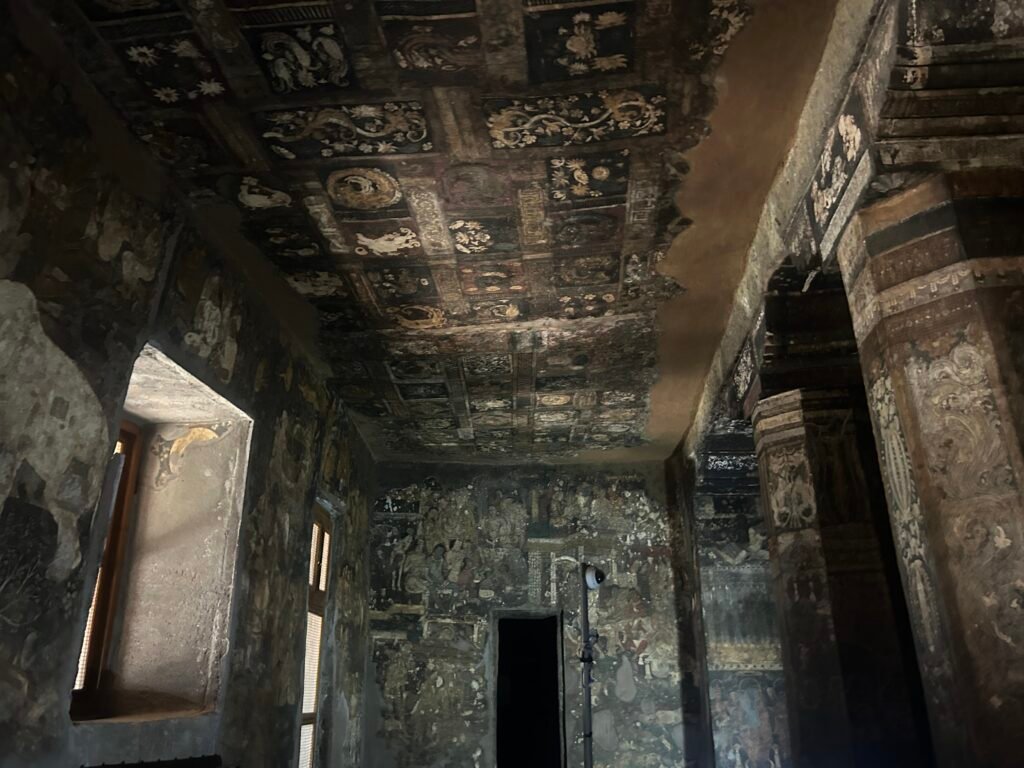
At Ajanta, looking is never immediate. The eyes need time to adjust — not just to darkness, but to expectation. What seems absent at first slowly gathers presence. Colour arrives hesitantly. Faces emerge not by declaration, but by permission. Light here does not reveal; it negotiates.
Inside the caves, illumination is never even. It slips along curved walls, pauses in recesses, retreats into shadow. Murals respond to this unevenness, changing character as the day moves. What feels muted in the morning sharpens briefly by noon, only to soften again as light thins. Nothing holds steady for long. Seeing becomes an act of patience rather than recognition.
Looking up at the murals requires stillness. The neck strains slightly. The body adjusts. Unlike Ellora, where movement carries understanding, Ajanta demands suspension. You stand longer than planned, waiting for forms to surface — a hand gesture, a gaze, the outline of a face that seems to watch back only when the light allows it. Attention narrows. The outside world recedes.
What is striking is how little the murals insist on being seen. There is no central image that claims dominance, no single narrative that demands comprehension. Figures overlap, stories unfold quietly across surfaces, and meaning refuses to arrive all at once. Light acts as an editor, deciding what is visible and what remains withheld. The murals do not change; your access to them does.
As the eyes adjust, looking begins to turn inward. The act becomes less about identifying scenes and more about sensing presence. Time slows. Breathing follows the rhythm of observation. The body learns how to be still without becoming rigid. Ajanta does not reward quick seeing. It responds to waiting.
There are moments when colour appears unexpectedly vivid — a fragment of blue, a line of red — only to dissolve again into shadow. These are not reveals; they are reminders. The murals are not objects to be captured fully. They exist in relation to light, movement, and duration. To see them completely would be to misunderstand how they are meant to be encountered.
Standing there, it becomes clear that Ajanta teaches a different way of looking. Not forward, not outward, but inward — toward detail, toward silence, toward the limits of perception. Light does not clarify meaning here. It complicates it, asking you to accept partial vision and incomplete understanding.
Leaving the cave, daylight feels abrupt. The eyes resist it briefly, still tuned to dimness and gradation. The murals remain behind, unchanged by your departure, waiting for the next pause, the next patient gaze, the next moment when light decides to offer just enough.
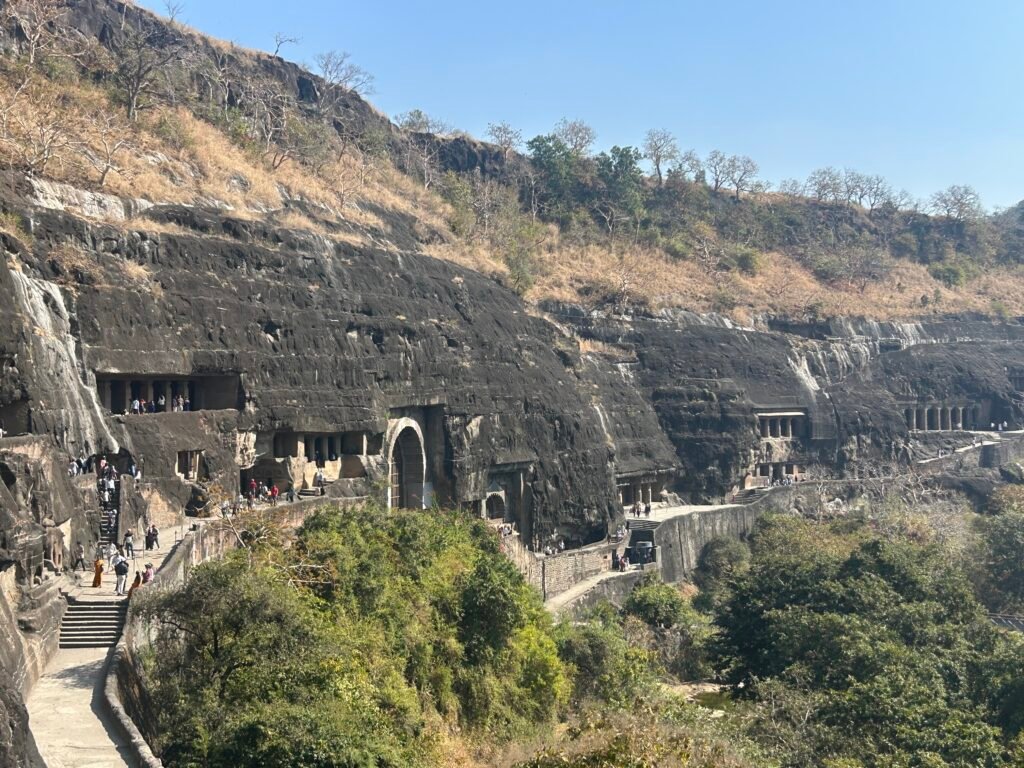
 . The sunlight penetrated directly into these caves on three periods through the day and it was synced accordingly by the locals for finishing the carvings and paintings. These could not be be done post sunset. There is another similar valley site nearby the Ajanta (as shared by my guide) , however which could not be used for the lack of these 3 divine interventions!